

Selected for Surrender

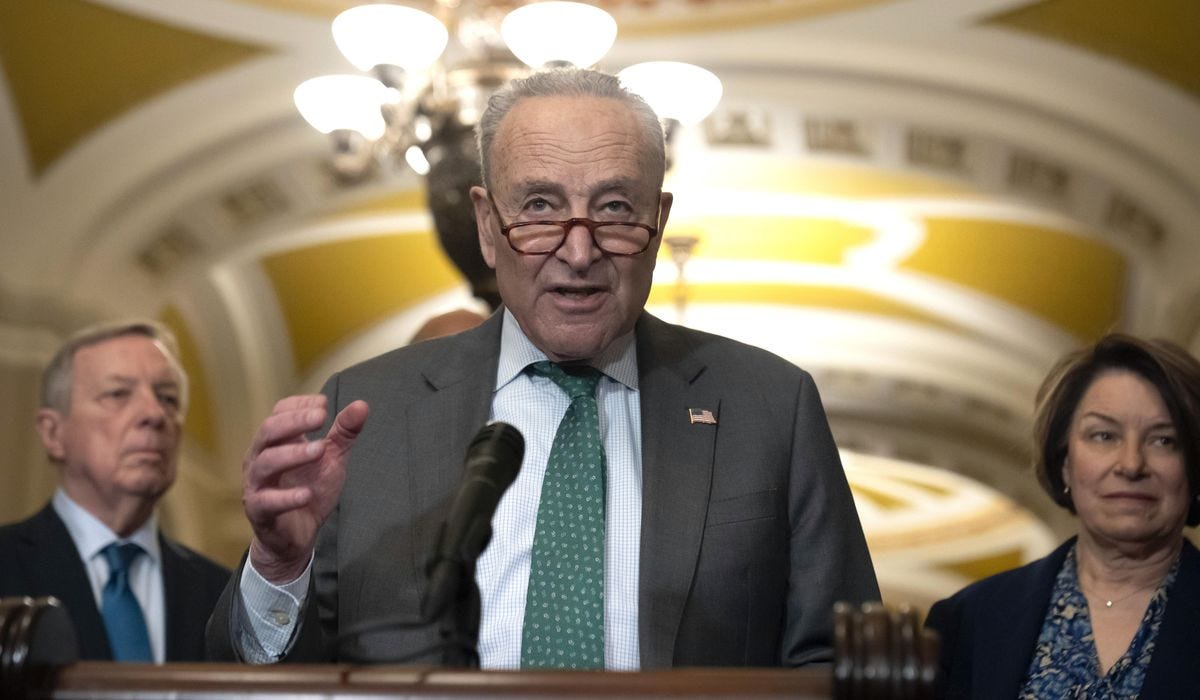
I’m still processing the surrender that Senate Democrats turned in over the weekend, less than a week after set of resounding victories. I’m not the only one.
Why did they do it? Why, after showing the first signs of political life in a year, did they throw it away for nothing?
There are theories flying around out there—that they couldn’t bear the human costs, that they were trying to preserve the filibuster, that it was a strategic move to make President Trump live with the political costs of cutting healthcare, that they simply lost their nerve. All of that is probably true, but I would add that senators are often committed institutionalists, too concerned about the norms of the Senate and their political relationships, and that precludes bold action in times like this.
I’ve assumed that’s learned behavior. Spend enough time in a coveted position and you get captured by it; you start to serve the institution rather than your cause and your constituents. I was reading a Substack post about scientific research this morning that made me see it differently:
A generation of scientists have internalized the habits of caution. Across the U.S. and Europe, surveys show that more than 70% of researchers believe the funding system discourages high-risk ideas, and over half report spending at least a quarter of their time on grant writing and administration. The average age at which American scientists receive their first NIH R01 grant has risen from just over 36 in 1980 to above 43 today, signaling a system that increasingly backs proven track records rather than bold potential.
Administrative load, risk aversion, and short grant horizons push creative researchers toward safe, fundable problems. In one study, only 14% of NIH grant reviewers said they prioritize novelty when evaluating proposals, while nearly all emphasized feasibility and preliminary data.
That post is fascinating on its own terms, but it reminded me instantly of my own ongoing experience running for Congress. “Habits of caution,” “back[ing] proven track records rather than bold potential,” and even “safe, fundable problems” all sound exactly like this experience.
Here’s how it works. Nobody will hear what a candidate has to say until they can get the public’s attention. Sometimes, you can earn attention by doing or saying the right thing at the right moment, but it’s difficult to do when everyone else in the world is also trying to do that. So, you have to pay for attention, and that means raising money. For a congressional race, a few people are wealthy enough to self-fund or raise enough from their friends, and a very few can raise enough from small donations online—but, again, you need attention to do that. Most candidates end up calling wealthy people or political action committees (PACs) and asking for money.
What do those donors look for in a candidate? Above all, a safe bet: they want to know that you can win. How do you become a safe bet? If you’ve been in politics for years, if you’ve made all the right connections, if you’ve been successful raising money in the past. And the rest of the political environment creates a reinforcing cycle: news outlets define the frontrunners based on money raised, endorsements go to them, and the next round of donors doubles down. By the time voters hear from candidates, they’ve already been filtered through this process.
On one level, it all makes sense. Donors don’t want to throw money away on long-shot candidates. The news doesn’t want to waste people’s time on candidates with no chance. Interest groups want to be on the winning team.
But, this system is also the source of the Democratic Party’s dysfunction and inertia, as manifested in the shutdown surrender. As an evolutionary environment, what does it select for? Candidates who are familiar, who change predictably with the winds, who don’t rock the boat, who have methodically built themselves toward the job and will do anything to get and keep it. Candidates who are good investments.
Case in point: at a candidate forum recently, we were asked whether we’d support Hakeem Jeffries as leader and potentially speaker. Three of us, including the other first-time candidate and me, answered no. In my case, it’s because I’ve been waiting for Democrats to offer the country a larger vision, and Jeffries hasn’t done that. But one candidate, a frontrunner who’s been in elected office for more than a decade and who’s raised a staggering amount from large donors, hedged. He said he’d want to pick the best person for the job.
Every senator and member of Congress passed through this system. Some of them are gifted enough to make it through with their fire and clarity and passion intact, but I suspect most candidates like that get filtered out quickly. So, we’re left to confront a rapacious, outlaw administration with the safe bets.
In other words: the capitulation didn’t happen over the weekend. It happened years earlier, when our political system chose people who would inevitably cave.
What can we do? We can’t wait for the donors, and the media, and the interest groups to come around. It’s up to us as citizens. Like early-stage investors, we have to make bets based on promise, not familiarity. We have to look for the people who can do what needs to be done and back them, even if everything around us pushes us toward a default choice. In my case, I couldn’t find that candidate, so I decided to run myself. Wherever you are, look for them in your communities. Taking back the country is not a matter of one vote or one election. It starts with choosing a generation of leaders unwilling to be safe bets.
